2026-03-23
This article provides an in-depth comparative analysis of two leading privacy-oriented operating systems: PlugOS and Tails OS. While both aim to protect user privacy and data security, they are founded on fundamentally divergent design philosophies and technical architectures. Tails OS employs an amnesic software model, achieving anonymity by running a temporary, non-persistent operating system on existing PC hardware. However, because Tails inherently relies on the host machine’s CPU, memory, and firmware, it faces intrinsic limitations in its level of isolation and trust. In contrast, PlugOS pioneers a trusted computing paradigm based on a self-contained hardware enclave, which physically isolates all computation and storage from the host device. This analysis systematically demonstrates that PlugOS holds a generational advantage over Tails across critical domains, including hardware architecture, isolation level, platform compatibility, functional flexibility, and physical security. The findings indicate that PlugOS not only provides a more robust security model capable of withstanding hardware-level threats but also offers a far more comprehensive and forward-thinking solution for the modern user through its cross-platform capabilities.
Introduction: The Evolving Landscape of Digital Privacy
For more than a decade, Tails OS has been the go-to choice for activists, journalists, and privacy-conscious users who need a live operating system with strong anonymity features. Tails runs from a USB stick, routes traffic through Tor, and leaves no trace on the host computer.
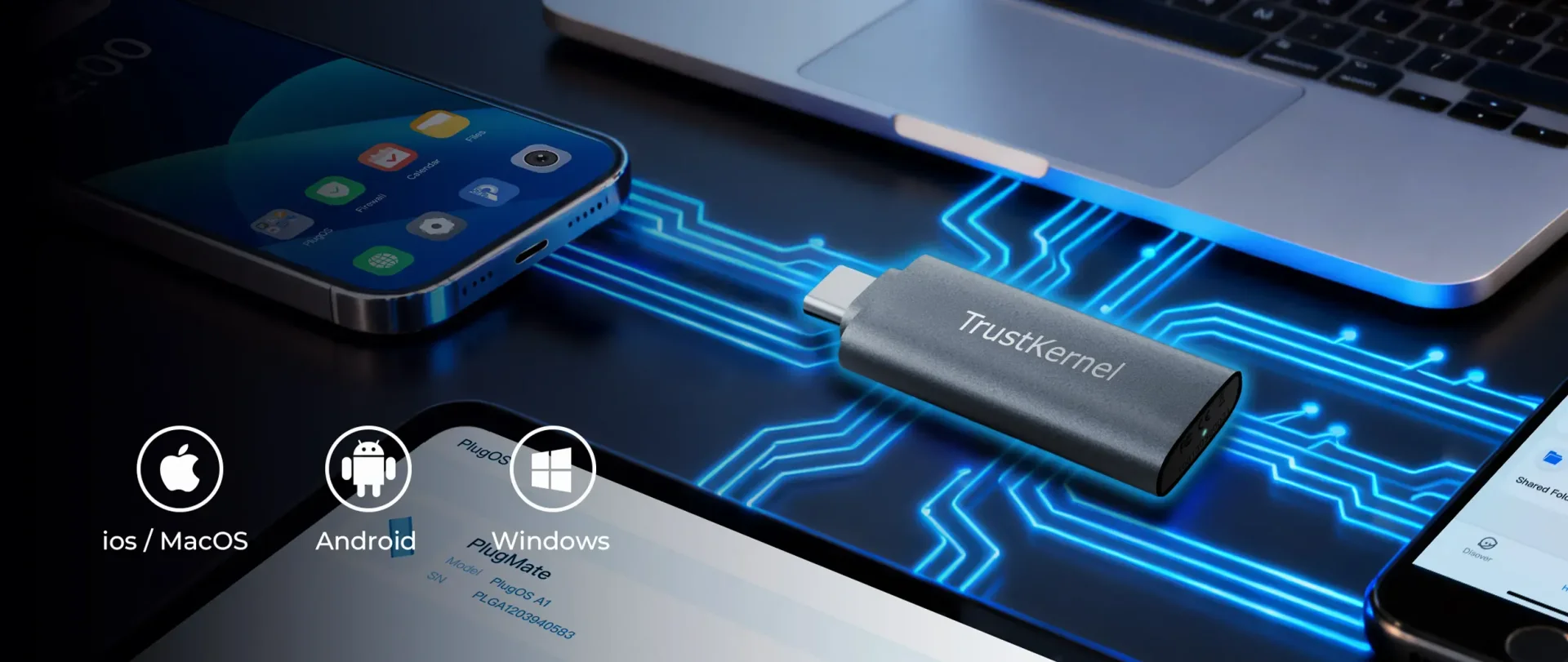
However, the privacy landscape has shifted. Mobile devices dominate daily life, threats have grown more sophisticated, and new hardware-based security models have emerged. This is where PlugOS, a plug-and-play secure operating system on independent hardware, offers a fundamentally different approach. Unlike Tails, PlugOS is not tied to PCs, nor does it rely on the host machine’s processor or memory. Instead, it brings its own SoC, RAM, and secure storage—transforming any phone or computer into a trusted privacy terminal.
The Architectural Divide: A Chasm of Hardware and Form
The most profound difference between PlugOS and Tails lies in their foundational hardware architecture. This chasm defines their respective levels of isolation, their trust anchors, and ultimately, their security ceilings.
Tails OS: A Software Fortress on Borrowed Land
Tails operates on a model of “borrowed hardware, software isolation”. When a user boots from a Tails USB drive, the system commandeers the host PC’s CPU, RAM, system bus, and GPU. Its security relies on an amnesic design where data is wiped upon shutdown, but its security boundary remains fundamentally coupled to the host hardware. This isolation manifests in two ways:
- Boot-Time Isolation: It bypasses the host’s primary operating system (e.g., Windows) stored on the hard drive, avoiding threats resident there.
- Runtime Isolation: It creates a sandboxed environment within the host’s RAM and enforces network isolation by routing all traffic through Tor.
While effective against threats stored on the host’s disk, Tails’s fatal flaw is the absolute trust it must place in the hardware it borrows. Its entire security model rests on the fragile assumption that the PC’s hardware and firmware are clean. If this assumption is violated, the entire fortress can crumble:
- Firmware-Level Threats: Malicious code implanted in the PC’s BIOS/UEFI can seize control before Tails even boots, allowing it to monitor or manipulate the OS in memory.
- Hardware Keyloggers: Physical or firmware-based keyloggers can intercept all user input, including passwords, completely bypassing the Tails operating system.
- DMA (Direct Memory Access) Attacks: Malicious peripherals connected via ports like Thunderbolt can use DMA to directly read from or write to the RAM used by Tails, circumventing all software-based protections.
Therefore, Tails provides a conditional and bounded form of software isolation. It can defend against the evils of software but is largely defenseless against the evils of the hardware itself.
PlugOS: A Hardware Enclave with a Self-Contained Trust Anchor
PlugOS operates on a model of “self-contained hardware, physical isolation”. It is a fully integrated, independent micro-computer, containing its own processor (SoC), RAM, and storage. Its relationship with the host device is not one of borrowing but of command.
The trust anchor for PlugOS is its own internal, verifiable hardware, not the uncontrollable external environment. This architecture fundamentally neutralizes the threats that plague Tails:
- Immunity to Host Hardware Threats: All sensitive computations—such as password verification, data decryption, and transaction signing—occur on the PlugOS’s internal SoC. The host PC’s CPU and RAM are never involved. Even if the host is thoroughly infected, it can only observe the encrypted I/O stream between PlugOS and its client app, never the core plaintext data or computations.
- True Physical Isolation: The connection between PlugOS and its host is a well-defined, protocol-limited I/O channel. The host is demoted to a set of “dumb” peripherals, providing only display, input, and network proxy functions. It has no ability to inspect or interfere with the internal execution environment of PlugOS. This constitutes a far more robust physical isolation.
Architecturally, Tails and PlugOS belong to different generations. Tails attempts to pitch a temporary tent on untrusted ground, while PlugOS arrives with its own trusted, solid foundation upon which a permanent fortress is built. This difference in isolation level is decisive.
In short, Tails is a parasitic software environment living on a host, while PlugOS is a self-sufficient secure computing unit with its own sovereign resources.
Overwhelming Advantages in Ecosystem and Functionality
This generational gap in hardware architecture gives PlugOS overwhelming advantages in platform compatibility and functional flexibility.
Platform Universality: A Legacy of the PC Era vs. The Future of All-Platform Computing
Tails is confined to PC devices and cannot support mobile platforms, whereas PlugOS covers PCs, Android, and iOS, offering a lower barrier to entry and far greater versatility.
- Tails: Locked into the PC Architecture. The viability of Tails depends on the open boot architecture (BIOS/UEFI) of x86 PCs. While this allows it to be a bootable USB drive, it is also its cage. In today’s mobile-first world, both iOS and Android devices use locked bootloaders and entirely different ARM architectures. It is technically impossible for Tails to run on these devices. It is a product of a bygone era.
- PlugOS: Natively Cross-Platform by Design. Through an ingenious I/O virtualization technique, PlugOS is independent of any platform’s specific boot protocol. It only requires the host device to run a lightweight client application, enabling seamless access across all major computing platforms: Windows PCs, Macs, Android phones/tablets, and iOS devices. For the modern user who needs to manage sensitive data across multiple devices, PlugOS offers a level of convenience and continuity that Tails cannot approach.
Functional Flexibility: The Niche Specialist vs. The All-in-One Platform
A common misconception is that Tails’s network security is its exclusive domain. However, network anonymity is fundamentally a feature that can be implemented in software.
- Network Security: Tails’s core value is intrinsically tied to its mandatory use of the Tor network. As a full-fledged secure Android system, PlugOS has an open app ecosystem. Users can choose to install and run Orbot (a Tor client), various VPNs, or other proxies to achieve the same level of network security as Tails, or even greater flexibility. In other words, PlugOS can easily become a “secure system with Tor,” but Tails can never become a “hardware-isolated computing platform.”
- Amnesia and Persistence: Tails’s soul is its “amnesic” nature, but for practicality, it had to add a somewhat contradictory “persistent storage” feature. PlugOS offers a more intuitive choice: its default state is a persistent “digital safe” for secure storage and work, while also offering “amnesic” or “guest” modes that leave no trace after use. This flexibility allows it to handle both serious work and tasks requiring ephemeral sessions.
- Physical Security: This is where PlugOS has an unassailable advantage. It supports brute-force self-destruct (hardware-level data wipe after a set number of incorrect password attempts) and a duress code (entering a predefined alternate password unlocks a decoy environment while silently wiping the real data). These features are designed to counter extreme physical threats—a domain that Tails, as a pure software system, cannot address.
Rethinking Use Cases
Tails is positioned for PC users like investigative journalists and activists who need temporary, anonymous web access. PlugOS serves this audience and expands far beyond it to include enterprise mobile workers, privacy-conscious individuals, and government/military sectors. This is thanks to PlugOS’s support for a vast array of security features, such as:
- Long-term, multi-layered data storage (secure/hidden volumes).
- Mobile terminal support (plug-and-play on Android/iOS).
- Hardware self-destruct and duress wipe capabilities.
- Enterprise-grade trust management (multi-device attestation, asset protection).
The Crypto Asset Management use case is a perfect example of PlugOS’s generational advantage. The core of crypto security is the absolute protection of private keys. While Tails can hide the IP address of a transaction, the signing process still occurs in the PC’s CPU and RAM. If the PC hardware is compromised, the private key is at risk. PlugOS, however, encapsulates the entire wallet application and signing process within its own secure hardware. The private key never leaves this “hardware safe.” For the core requirement of asset security, PlugOS provides not just a “better” solution, but the only architecturally sound one.
Conclusion: More Than a Replacement, a Paradigm Shift
Tails OS and PlugOS represent two distinct paths in privacy protection: the former is an “anonymous operating system” dependent on host hardware, while the latter is a “portable trusted system” based on its own independent hardware. PlugOS can cover the majority of Tails’s use cases while expanding to create far broader value through hardware isolation and cross-device compatibility. From both an academic and industrial perspective, PlugOS is an evolution and generalization of the Tails model.
The conclusion of this analysis is clear:
- On Foundational Security: PlugOS’s hardware isolation architecture represents a generational leap over Tails’s software isolation, offering fundamental immunity to underlying hardware threats.
- On Ecosystem and Application: PlugOS’s cross-platform mobility perfectly aligns with modern user behavior, while Tails remains confined to the shrinking island of the PC.
- On Functional Capability: PlugOS is a flexible, all-in-one platform that can deliver all of Tails’s features on-demand, while also providing a level of physical security that Tails cannot.
For individuals and organizations seeking the highest level of security today, choosing PlugOS over Tails is not a simple matter of feature preference. It is a choice for a more robust, comprehensive, and future-proof security paradigm. PlugOS represents the future of personal trusted computing.
Subscribe: Get latest security insights and exclusive updates early
 PlugMate — Smart & Portable Privacy-Controlled Device
Secure, Ad-free, Tracking-free, No Telemetry
Copyright © 2024-2026 TrustKernel
Privacy Policy | User Service Agreement