2026-03-23
In a world where smartphones and tablets have become our “super terminals,” an array of sensors—cameras, microphones, gyroscopes, accelerometers, and GPS—are deeply embedded in our devices. While they bring us conveniences like photography, navigation, and fitness tracking, they also constitute a massive, invisible threat to our privacy.
For a long time, we’ve relied on operating system permission management to protect our privacy. But this system has proven to be a never-ending “cat-and-mouse” game. For instance, even with GPS permissions disabled, malicious apps can still use Wi-Fi hotspots, Bluetooth beacons, or even cell tower data to infer a user’s location. This isn’t just a permission-bypassing issue; at its core lies a deeper threat: sensor fingerprinting.
Patching the existing permission system cannot fundamentally solve the privacy leakage problem. This is why PlugOS has adopted a radical solution: completely removing all local physical sensors from its hardware architecture. This design transforms PlugOS into a true “sensing sandbox.” By being physically isolated from the host device’s sensing layer, it eliminates any form of hardware-level fingerprinting at the source.
The Root Problem: Hardware Sensors as Invisible Privacy Collectors
Modern devices typically include over a dozen types of sensors: cameras, microphones, accelerometers, gyroscopes, GPS, ambient light sensors, barometers, fingerprint scanners, and facial recognition modules. While these components are intended to enhance user experience, each sensor can serve as a potential channel for privacy leakage. More critically, the data they expose is not merely localized; it can be combined to form a unique device identity (device fingerprint), enabling cross-application, cross-site, and even cross-device tracking.
Most users believe that by simply denying an app permissions, they can avoid being tracked. However, even with all app software permissions turned off, apps can still use sensors to create a hardware fingerprint, thereby tracking the device and exposing user privacy. This is because every sensor possesses unique hardware characteristics—what we call “sensor fingerprints.” These tiny differences arise from physical variances during the manufacturing process. For example:
- Accelerometers and Gyroscopes: Even when stationary, different devices have unique zero-point drift and noise patterns. Attackers can leverage these discrepancies, combined with a user’s daily behavior patterns, to generate a unique device identifier for cross-app tracking.
- Microphones: The distinct frequency response and background noise characteristics of different microphones can be collected, forming a unique acoustic fingerprint. Some apps even analyze ambient sounds through silent recording to indirectly deduce the user’s location.
- Cameras: The Photo Response Non-Uniformity (PRNU) of a CMOS sensor is a device-specific characteristic. Even without taking a photo, invoking certain image processing APIs can expose this unique feature.
- GPS and Location Modules: Even if a user denies location sharing, a combination of Wi-Fi, Bluetooth, and cell tower data can still be used to reverse-engineer a user’s movements, achieving highly accurate tracking.
- Ambient Light and Barometric Sensors: Minute changes in light and air pressure readings can be analyzed to help identify the specific environment a user is in, and even determine a floor or building structure.
By combining these sensor data points, attackers can build highly stable device fingerprints and achieve seamless tracking across apps and platforms. What’s more concerning is that this data collection is often done imperceptibly and without requiring any permissions. Users are often unaware that their privacy is being harvested and analyzed.
Limitations of Traditional Protection
Operating system permission management is theoretically capable of restricting app access to sensitive data, but in reality, it has significant vulnerabilities:
- Insufficient Granularity: The system cannot accurately inform users of the indirect leakage risks associated with granting a certain permission, such as the behavioral data generated by an accelerometer.
- User’s Inability to Assess Risk: Most users lack the technical means to identify potential leaks, and can only make a choice based on a simple “Allow/Den-y” button.
- Conflict of Interest: Commercial operating systems and app platforms rely on advertising and data monetization, so they have no incentive to proactively and comprehensively restrict data collection.
- Side-channel Attacks: Even when certain permissions are restricted, attackers can still infer a user’s status by combining other sensor data (e.g., Wi-Fi signals + accelerometer + light sensor).
As a result, traditional methods are essentially just “patching vulnerabilities” rather than eliminating the root cause. Privacy protection remains in a state of “passive defense.” When software-based protections are always one step behind the latest exploits, the only true solution is a hardware redesign.
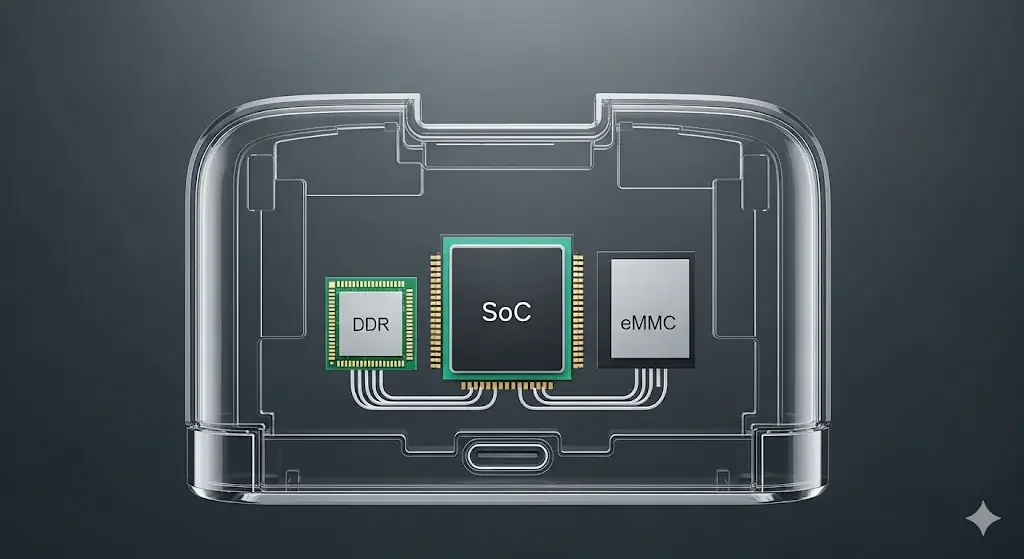
PlugOS Approach: Eliminating Risk at the Hardware Level
To tackle this challenge, PlugOS has adopted a fundamental solution: completely removing all local physical sensors from its hardware architecture. Our core principle is: If a capability doesn’t physically exist, it cannot be remotely activated, abused, or used for fingerprinting.
PlugOS is designed as a plug-in hardware system that connects to a host device (like a smartphone, tablet, or PC) via a USB-C port. In this architecture, PlugOS itself does not integrate any active sensing hardware. Instead, it uses hardware sensor virtualization to satisfy an app’s need for sensor availability while simultaneously protecting user privacy.
Key Technology: The Sensor Virtualization Mechanism (SVM)
Removing sensors doesn’t mean sacrificing functionality. PlugOS is not a “non-sensing” system. It transfers sensing capabilities to the host device and manages them through an abstraction layer called the Sensor Virtualization Mechanism (SVM).
The SVM workflow includes:
- Capability borrowing with secure isolation: PlugOS never directly accesses raw sensor data from the host. When an application requires such data, SVM temporarily and securely borrows the host’s sensors through a tightly controlled interface.
- Data standardization: All raw host data is normalized before entering the PlugOS environment, removing inherent hardware variations to prevent fingerprinting. For example, gyroscope readings from any host device are calibrated so that static data always appears as (0, 0, 0) to applications.
- Fine-grained permission and obfuscation: Users can precisely control virtual sensor availability, including enabling, disabling, or applying obfuscation to specific data streams.
Through SVM, PlugOS provides user-controllable virtual sensors, enabling a balance between functionality and privacy. Examples include:
- Virtual GPS: Fixed coordinates or time-varying simulated paths to protect real user locations.
- Virtual Microphone: Silent input or pre-defined audio streams to prevent eavesdropping.
- Virtual Camera: Pre-set images or blurred feeds to create a “visual sandbox.”
This capability-borrowing model converts data access from passive authorization into active, user-controlled governance.
Redefining the Essence of “Smart”
Mainstream systems cannot easily adopt this design because their business models rely on sensor data to feed advertising engines. As “smart” becomes synonymous with “full-time surveillance,” PlugOS chooses to go against the grain with its core advantages:
- Physical Anti-Eavesdropping: No microphone means you can never be listened to.
- Power Efficiency Leap: Removing sensors reduces power consumption by 30%.
- Termination of Hardware Backdoors: A chip-level self-destruct mechanism protects data sovereignty.
Genuine intelligence, in the PlugOS paradigm, is measured not by omnipresent sensing, but by controlled, trustworthy capabilities.
Conclusion: Defining a New Paradigm for Universal Privacy
PlugOS’s “zero-sensor” architecture offers a novel and powerful paradigm for solving the privacy challenges of the smart device industry. We believe that true privacy protection should not be a continuous patching of technical vulnerabilities, but rather a fundamental architectural redesign.
By eliminating sensor fingerprints at the physical level and using sensor virtualization to provide standardized data within a secure sandbox, PlugOS has successfully shifted privacy protection from a passive “arms race” to an active “architectural reconstruction.” It demonstrates to the world that when it comes to functionality and privacy, we do not have to compromise.
Subscribe: Get latest security insights and exclusive updates early
 PlugMate — Smart & Portable Privacy-Controlled Device
Secure, Ad-free, Tracking-free, No Telemetry
Copyright © 2024-2026 TrustKernel
Privacy Policy | User Service Agreement