2026-08-12
All statistics in this article are sourced from Usercentrics' authoritative guide, "Over 150 data privacy statistics companies need to know about in 2026," published in March 2025. The data aggregates findings from top industry analysis firms such as McKinsey, Gartner, Forrester, Pew Research Center, Cisco, and IBM. All data is from publicly available sources and has not been fabricated or altered in any way.
I. Global Data Privacy Landscape: Law, Enforcement, and Consumer Attitudes
A. Expansion of Global Privacy Legislation
Global data privacy legislation has experienced unprecedented expansion over the past five years:
● By the end of 2024, data protection laws covered 6.3 billion people, representing 79% of the global population.
● By the beginning of 2025, 144 countries worldwide had data and consumer privacy laws.
● By the beginning of 2025, 42% (21) of US states had passed data privacy laws.
● As of January 2025, the EU had implemented three fully functional online privacy-related laws, with another about to come into effect.
B. Enforcement and Fines Continue to Increase
Legislation is only the starting point; enforcement is key:
● Since the GDPR came into effect in May 2018, total fines have exceeded €4 billion.
● By 2024, The EU alone issued €2.1 billion in fines for GDPR violations.
● Of the world's largest privacy fines, Europe, the Middle East, and Africa (EMEA) accounts for 54%, and North America for 43%.
● The California Consumer Protection Act (CCPA) protects over $12 billion worth of personal information annually.
C. Public Support for Stricter Privacy Protection
Consumers' attitudes towards privacy protection are growing stronger:
● 62% of British citizens said they feel safer sharing data since the GDPR was implemented.
● Over 50% of US voters support national data privacy laws.
● 87% of US voters support banning the sale of personal data without consent.
● 86% support requiring companies to minimize data collection.
● 86% want stronger online privacy protections for children under 17.
● 82% believe individuals should have the right to sue after a data breach.
D. The Gap in Data Privacy Awareness and Understanding
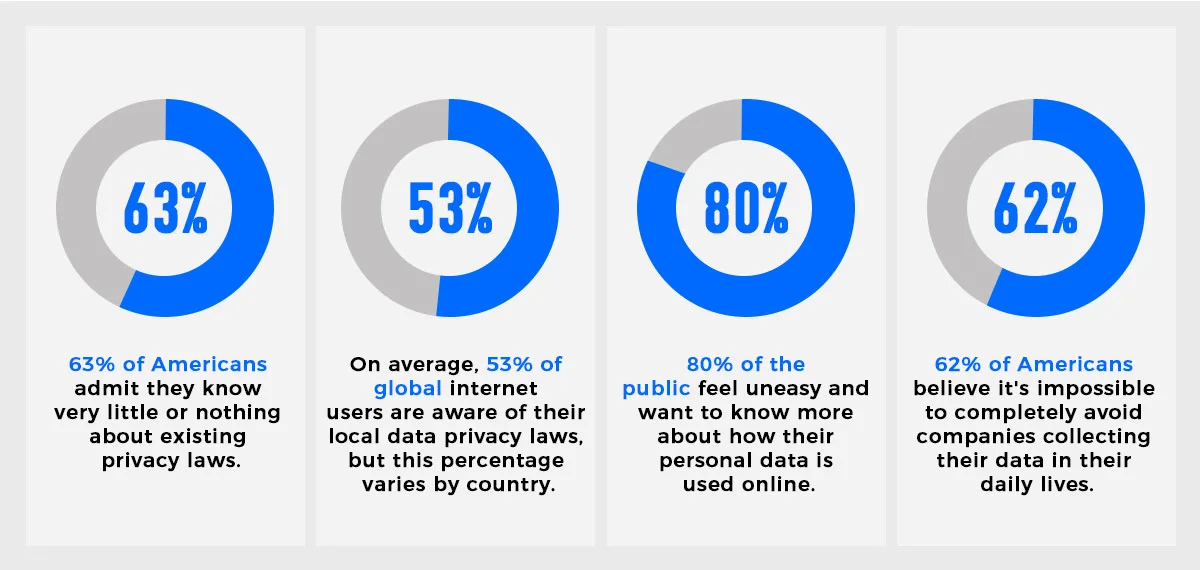
● 63% of Americans admit they know very little or nothing about existing privacy laws.
● On average, 53% of global internet users are aware of their local data privacy laws, but this percentage varies by country.
● 80% of the public feel uneasy and want to know more about how their personal data is used online.
● 62% of Americans believe it's impossible to completely avoid companies collecting their data in their daily lives.
E. A Sharp Decline in Trust in Companies
● As of May 2024, more than half of American adults said they would avoid companies that had experienced data breaches, and only 9% still trust these companies.
● In the UK, Spain, and the US, 75% of adults believe that technology companies have too much control over their data.
● Although all major privacy laws require privacy policies or similar notices, only one in five American users said they frequently or always read and agree to a company's privacy policy.
F. Business Benefits of Privacy Investments
● 79% of surveyed companies indicated that privacy laws have had a positive impact on their organizations.
● 95% of companies believe that investing in data privacy is worthwhile, with an average return of 1.6 times, and 30% of companies estimate a return as high as 2 times.
II. Data Privacy Trends: Key Focus in 2025-2026
A. Legislative and Regulatory Dynamics
New data privacy legislation will continue to be introduced in 2025 and beyond:
● Australia: Online Security Amendment (Minimum Age on Social Media)
● UK: Data (Use and Access) Act
● US: 8 state-level privacy laws in 2025, 3 in 2026
● Existing privacy laws in countries such as India, Japan, and Sri Lanka will be fully implemented or updated in 2025.
B. Corporate Privacy Investment Surges
● Global end-user spending on security and risk management is projected to reach $212 billion by 2025, a 15% increase from 2024.
● By the end of 2025, over 60% of large enterprises expect to use at least one privacy-enhancing technology (PET) solution.
III. Consumer Attitudes and Awareness of Data Privacy
A. Public Concern Regarding Data Processing
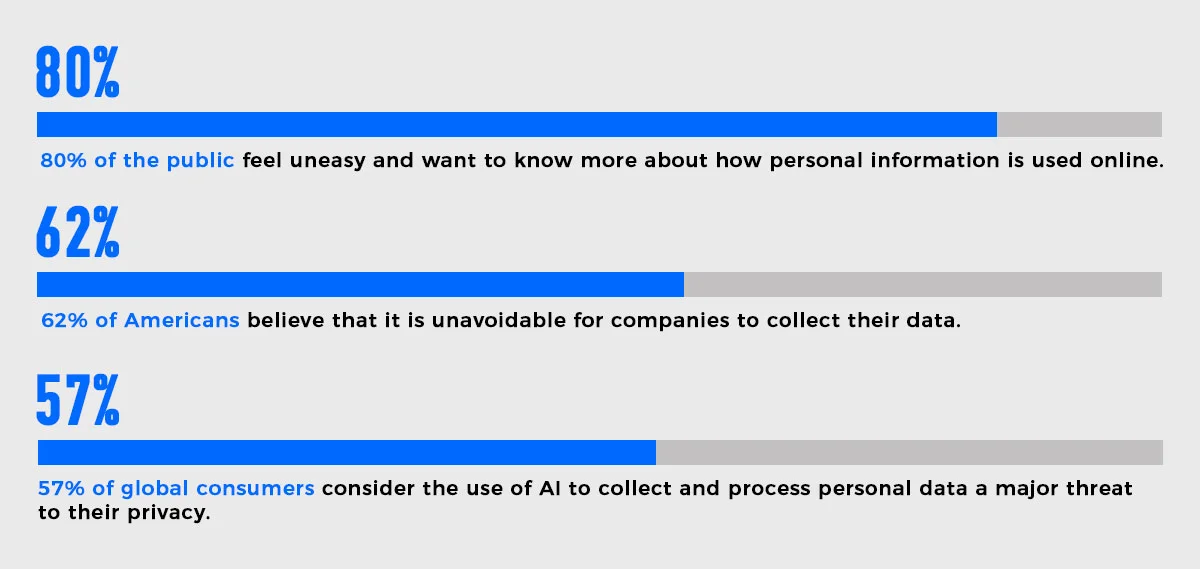
● 80% of the public feel uneasy and want to know more about how personal information is used online.
● 62% of Americans believe that it is unavoidable for companies to collect their data.
● 57% of global consumers consider the use of AI to collect and process personal data a major threat to their privacy.
B. Awareness and Use of Privacy Policies
● On average, 53% of global internet users are aware of local data privacy laws, but there are significant differences between countries.
● Only one-fifth of US users frequently or always read their company's privacy policy.
C. Trust in Tech Companies
● As of May 2024, over half of American adults would avoid companies that had previously leaked data, with only 9% still trusting them.
● 75% of adults in the UK, Spain, and the US believe tech companies have too much control over their data.
IV. Changes in Consumer Behavior Due to Privacy Concerns
A. Proactive Protective Measures Taken by Consumers
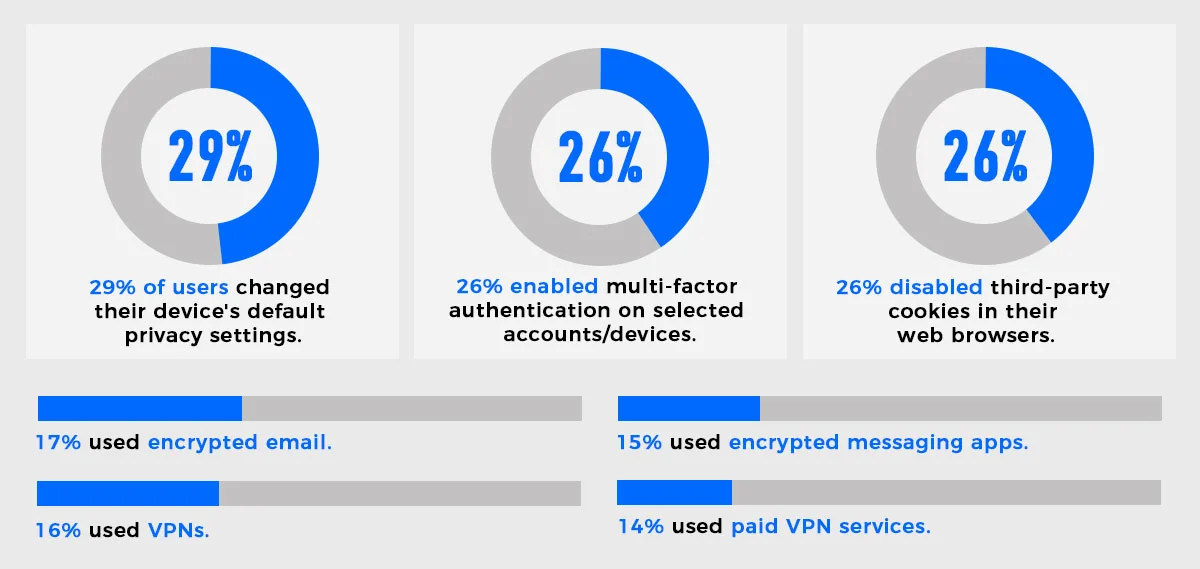
Data from Norton's 2022 Cybersecurity Insights Report shows:
● 29% of users changed their device's default privacy settings.
● 26% enabled multi-factor authentication on selected accounts/devices.
● 26% disabled third-party cookies in their web browsers.
● 17% used encrypted email.
● 16% used VPNs.
● 15% used encrypted messaging apps.
● 14% used paid VPN services.
B. Conditions for Willingness to Share Data
● 80% of consumers said they would be willing to share personal information directly with brands if it led to personalized marketing messages.
● 40% of the American public said they would be willing to share personal data if they knew exactly how and by whom their data would be used.
C. Privacy Concerns and Behavioral Changes on Social Media
● 89% of the public expressed serious concern about how social media platforms collect children's personal information.
● 31% of respondents had "absolutely no confidence" in social media companies' ability to protect their data.
● Only 18% of US social media users believed that Facebook could protect their data and privacy.
Regarding data collection: Statistics on "How US adults collect their personal data from social media platforms":
● 35% said "very worried"
● 44% said "somewhat worried"
● 17% said "not very worried"
● 4% said "not worried at all"
Regarding behavioral changes:
● 38% of respondents reduced their social media usage due to data privacy concerns.
● 36% of respondents said they had deleted social media accounts due to data privacy issues.
V. Enterprises and Data Privacy Compliance
A. Enterprise Investment and Challenges in Data Privacy
● 70% of US companies reported increasing consumer data collection in the past year.
● 82% of companies pursue privacy certifications (such as ISO 27701) Considered a sourcing criterion for selecting products or suppliers
● The cost of CCPA compliance is projected to reach $467 million to $1.64 billion between 2020 and 2030.
● 27% of large enterprises have spent more than $500,000 to achieve GDPR compliance.
● Only 25% of enterprises reported meeting the GDPR requirement to report data breaches within 72 hours.
● Only 37% of enterprises have an information governance framework that can adapt to evolving data privacy regulations.
● Among privacy professionals, only two out of ten are fully confident in their organization's compliance.
B. Data Breach and Cybersecurity Status Quo
Data breaches are becoming increasingly serious:
● Personal information (such as names, emails, and passwords) appears in 44% of data breaches.
● The annual cost of cybercrime is projected to reach $10.5 trillion by the end of 2025.
● The global cost of cybercrime is projected to increase by $6.4 trillion (69.41%) between 2024 and 2029.
● In 2024, the average cost of a data breach increased by 12% year-on-year, reaching $4.62 million.
● Phishing attacks accounted for nearly 30% of all data breaches globally in 2024.
● The average cost per breach for phishing and business email attacks is $4.88 million
Vulnerabilities Across Industries:
● Manufacturing accounted for nearly a quarter of global cyberattacks in 2023, ranking first among all industries.
● The financial and insurance industry followed closely, accounting for approximately 18%.
● Professional, business, and consumer services ranked third, accounting for 15.4%.
● Ransomware attacks in the healthcare industry cost an average of $10.93 million per attack.
The good news is that a 2024 survey of over 200 US small and medium-sized enterprise leaders and IT professionals showed that:
● Over 90% of businesses notify customers after a data breach.
● Only 5% of businesses do not notify customers.
VI. Artificial Intelligence and Data Privacy-The Biggest Opportunity and Risk
A. Consumer Concerns about AI
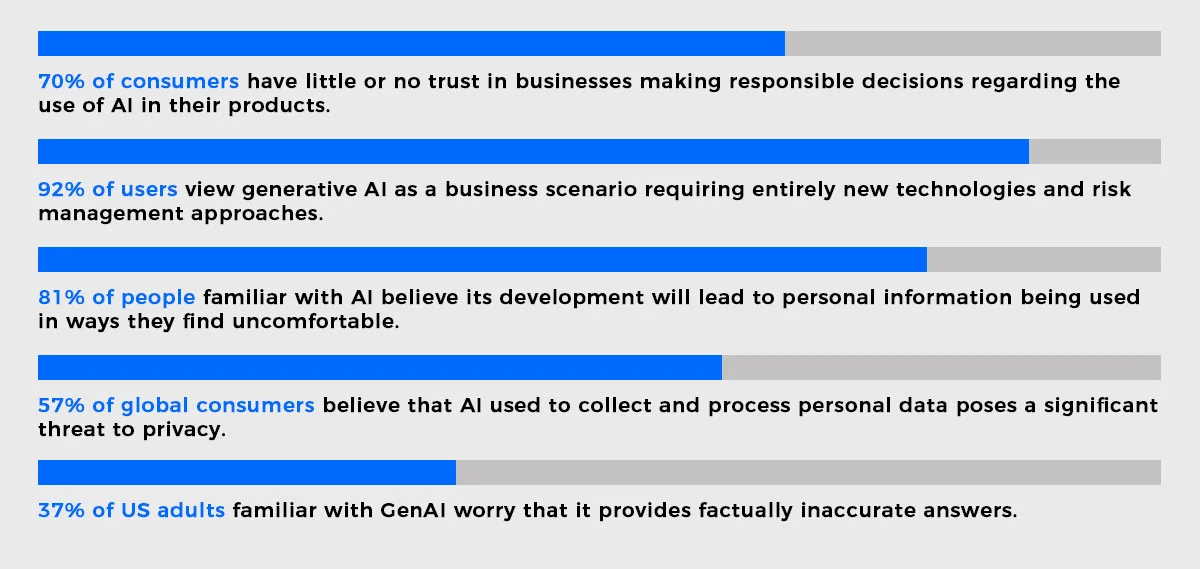
● 70% of consumers have little or no trust in businesses making responsible decisions regarding the use of AI in their products.
● 92% of users view generative AI as a business scenario requiring entirely new technologies and risk management approaches.
● 81% of people familiar with AI believe its development will lead to personal information being used in ways they find uncomfortable.
● 57% of global consumers believe that AI used to collect and process personal data poses a significant threat to privacy.
● 37% of US adults familiar with GenAI worry that it provides factually inaccurate answers.
B. Current Status and Risks of AI Use in Enterprises
● 40% of enterprises have experienced AI privacy breaches.
● 5% of employees regularly input company data into ChatGPT, with over a quarter of this data being sensitive information.
Sensitive Data Types Input by Employees into GenAI Tools:
● Internal Business Data: 43%
● Source Code: 31%
● Personally Identifiable Information (PII): 12%
Restrictions on AI Use by Enterprises:
● 63% of enterprises restrict the types of data that can be input into GenAI tools.
● 61% limit the scope of GenAI tools that can be used.
● 27% completely prohibit the use of GenAI tools.
C. The Bright Side of AI Applications
● 62% of Americans who have heard of AI believe that as enterprises use AI to collect and analyze personal information, it will make life more convenient.
● Enterprises that deploy AI and automation in their secure operations save an average of $2.22 million per data breach.
VII. The Business Value of Investing in Data Privacy
A. ROI on Privacy Investments
● Total data privacy spending more than doubled between 2019 and 2024.
● Over 70% of business professionals reported "significant" or "very significant" benefits from their data privacy efforts.
● Over 40% of businesses saw benefits at least twice their privacy spending.
● For every $1 spent on privacy, companies received an average of $2.70 in associated benefits.
B. Rapid Growth of the Data Privacy Software Market
● The global data privacy software market is projected to grow from $5.37 billion in 2025 to $45.13 billion in 2032, representing a CAGR of 35.5%.
● The US data privacy software market is projected to reach $17.19 billion by 2032.
● The adoption rate of consent management platforms by SMEs is projected to be 10.6% (CAGR).
C. Overall Acceptance of Privacy Investments
● 95% of companies reported that the benefits of their data privacy investments outweighed the costs.
● 79% of companies reported that privacy laws had a positive impact.
VIII. Three Key Action Recommendations
● Gaining Customer Trust: It's not just about protecting data, but demonstrating to customers that you can protect it. Clearly explain what technologies you use to solve which privacy issues and present a complete and credible solution. Treat customer data as a privilege, not a right.
● Privacy as a Competitive Advantage: This is not just a compliance issue, but a way to differentiate yourself. Strong privacy practices reduce risk, build customer trust, and ultimately benefit profits. Create privacy-first products and systems, empower users to control their data, and make privacy a core part of your brand-customers are more loyal to companies they trust.
● Remain Vigilant About New Technologies: As AI and other technologies continue to evolve, privacy must be a priority. Develop ethical guidelines, conduct due diligence on new tools, maintain transparency in AI practices, and train teams to identify privacy risks and take preventative measures in daily operations.
IX. TrustKernel's Philosophy and Actions
A. TrustKernel's Value Philosophy
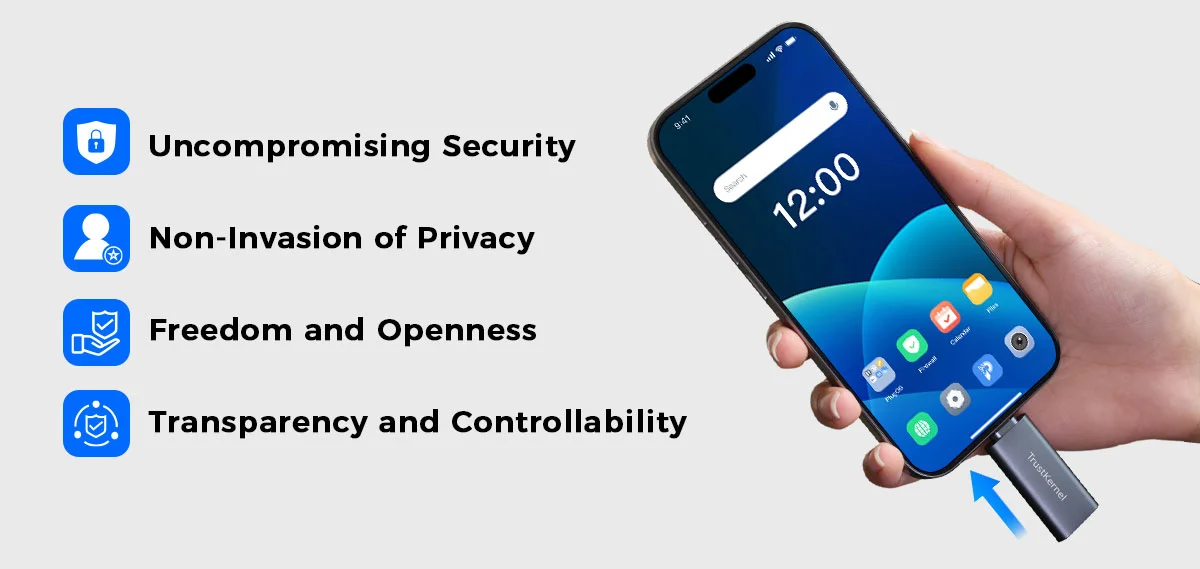
● Uncompromising Security
Building a hardware-level encryption and isolation architecture to ensure user data cannot be stolen or reconstructed.
● Non-Invasion of Privacy
Truly zero data collection, zero behavioral analysis, and zero advertising. The user's digital footprint belongs only to the user.
● Freedom and Openness
Creating an ecosystem compatible with mainstream applications, without restricting user choices, ensuring an ultimate freedom experience.
● Transparency and Controllability
Returning all control back to the user, giving users complete knowledge and decision-making power over their digital assets and behavior.
B. TrustKernel's Solutions
TrustKernel is committed to empowering every user to truly control their digital life and enjoy freedom, privacy, and choice. To this end, based on over ten years of accumulation and insight into underlying security technologies, we have developed the PlugMate small personal privacy computer based on the PlugOS security system.
PlugOS is a hardware-isolated, secure Android-based operating system that runs on thumb-sized devices. It instantly provides any iPhone, Android phone or tablet, Mac, and Windows PC with a physically isolated private workspace for handling sensitive tasks, identity, data, and communications.
X. Conclusion
Privacy is a core issue everyone must confront today. On the one hand, 80% of the public is uneasy about how their data is used; on the other hand, the vast majority admit they lack understanding of privacy laws and are powerless to change the status quo. A huge gap exists between consumer anxiety and action.
The key to bridging this gap cannot rely on unilateral corporate promises, but rather on truly returning control to the users. This is precisely the starting point of TrustKernel. PlugOS's mission is to create a personalized, trustworthy, independent, and portable intelligent digital system for every user. Privacy should not be a privilege, but a right. Technology should protect it, not erode it.
Article source
- Usercentrics (2025). Over 150 data privacy statistics companies need to know about in 2026.Available at: https://usercentrics.com/guides/data-privacy/data-privacy-statistics/
- McKinsey & Company (2019). GDPR compliance since May 2018: A continuing challenge. Available at: https://www.mckinsey.com/capabilities/risk-and-resilience/our-insights/gdpr-compliance-after-may-2018-a-continuing-challenge
- Gartner (2022). Gartner Identifies Top Five Trends in Privacy Through 2024. Available at: https://www.gartner.com/en/newsroom/press-releases/2022-05-31-gartner-identifies-top-five-trends-in-privacy-through-2024
- Forrester (2024). What To Know: A Retrospective Of 2023's Top Breaches And Fines. Available at: https://www.forrester.com/blogs/what-to-know-a-retrospective-of-2023s-top-breaches-and-fines/
- Pew Research Center (2023). How Americans View Data Privacy: Tech Companies, AI, Regulation, Passwords and Policies. Available at: https://www.pewresearch.org/internet/2023/10/18/how-americans-view-data-privacy/
- Cisco (2024). Cisco 2024 Consumer Privacy Survey. Available at: https://www.cisco.com/c/en/us/about/trust-center/consumer-privacy-survey.html
- IBM (2024). IBM Report: Escalating Data Breach Disruption Pushes Costs to New Highs. Available at: https://newsroom.ibm.com/2024-07-30-ibm-report-escalating-data-breach-disruption-pushes-costs-to-new-highs
Subscribe: Get latest security insights and exclusive updates early
 PlugOS — Privacy isn't an option. It's the foundation
Secure, Ad-free, Tracking-free, No Telemetry
Copyright © 2024-2026 TrustKernel
Privacy Policy | User Service Agreement