2026-07-22
La paradoja de la privacidad en la IA
La IA ya no es solo una herramienta que responde preguntas: se está convirtiendo en un agente que trabaja por ti. Hace un año le pedías a la IA que resumiera un artículo o redactara un correo. Ahora, los agentes de IA pueden procesar tu bandeja de entrada, revisar contratos, escribir código, llamar a APIs e incluso controlar aplicaciones y bases de datos.
¿La pega? Cuanto más útil es la IA, más necesita saber de ti. Para hacer su trabajo, un agente puede necesitar acceso a tus correos personales, archivos, código fuente, datos de clientes, registros financieros, credenciales de acceso, memoria a largo plazo y servicios de terceros.
Así que en la era de los agentes de IA, lo que hay que proteger no es solo una única consulta. Es todo el espacio de trabajo digital al que la IA puede acceder mientras trabaja en tu nombre. Cuanto más sabe la IA y más acceso tiene, mayores son las apuestas de privacidad y seguridad.
IA en la nube: gran poder, mayor confianza
Los modelos de IA más potentes de hoy viven en la nube, porque requieren enormes cantidades de cómputo que tu teléfono u ordenador simplemente no pueden aportar. Los modelos grandes, las ventanas de contexto largas y las tareas complejas de agentes exigen recursos muy superiores a lo que la mayoría del hardware local puede ofrecer.
Así que cuando usas IA avanzada, inevitablemente envías tus consultas, archivos y contexto a un entorno en la nube. Eso significa confiar en que el proveedor de IA y su infraestructura en la nube gestionarán tus datos de forma responsable. Pueden tener políticas de privacidad, controles de acceso y auditorías internas, pero al fin y al cabo, el modelo sigue basándose en gran medida en la confianza: «Confía en que no miremos».
Y si tus solicitudes pasan por proxies, pasarelas u otros intermediarios, cada salto adicional crea otro lugar donde los datos en texto plano podrían quedar expuestos, y otra parte en la que debes confiar.
Para datos verdaderamente sensibles, la mejor pregunta es: ¿Podemos hacer que sea técnicamente difícil que terceros no autorizados los vean, en lugar de simplemente pedirles que no lo hagan?
Esa pregunta cobra aún más importancia en el caso de los agentes de IA. No solo procesan consultas puntuales; trabajan con datos que se acumulan continuamente y que pueden abarcar tu vida personal y profesional.
IA en el dispositivo: mejor privacidad, capacidad limitada
La respuesta obvia es ejecutarlo todo localmente. Si la IA se ejecuta en tu dispositivo, tus datos nunca tienen que salir de él.
Pero los dispositivos locales tienen límites estrictos en cuanto a cómputo, memoria y batería. Simplemente no pueden ejecutar los modelos más grandes, manejar ventanas de contexto muy largas ni realizar razonamientos complejos de múltiples pasos tan eficazmente como la infraestructura en la nube.
Así que te quedas con un compromiso:
- En el dispositivo: tus datos siguen siendo privados, pero la IA es menos capaz.
- En la nube: la IA es más potente, pero tienes que confiarle tus datos.
Esa es la paradoja de la privacidad en la IA. Los datos que más te importa proteger son a menudo los mismos a los que la IA más potente necesita acceder.
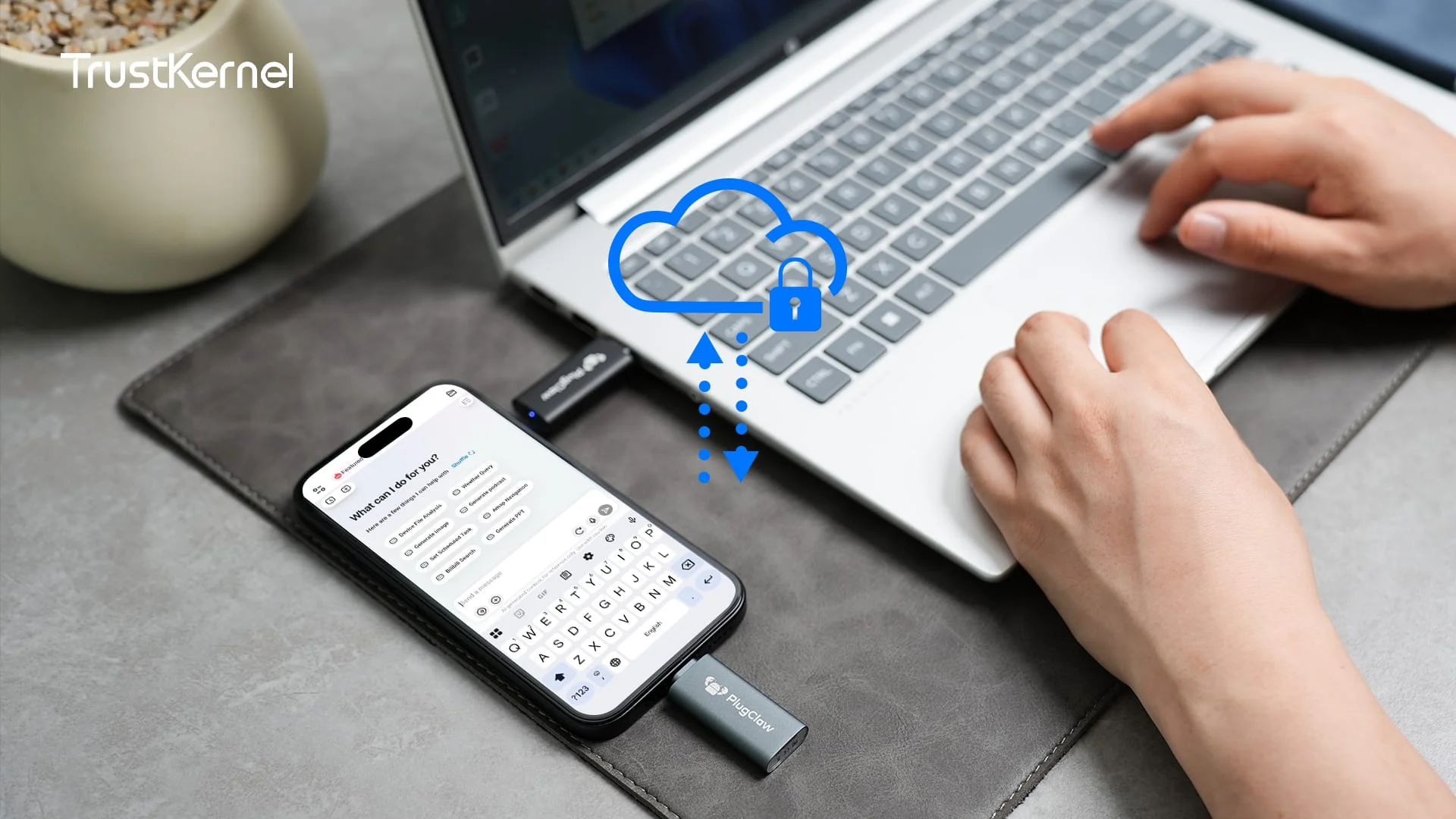
¿Qué es la IA confidencial?
Como no podemos confiar del todo en las promesas de la nube, y no podemos permitirnos empeorar nuestra IA, necesitamos una tercera vía: la potencia de cómputo de la nube con una protección de privacidad casi local.
Para eso existe la IA confidencial.
La seguridad de datos tradicional se centra en dos estados: datos en reposo y datos en tránsito. Pero la IA introduce un tercer estado, más complicado: datos en uso.
Durante el cómputo, un modelo tiene que procesar datos en texto plano para generar resultados. Es justo entonces cuando los datos sensibles deben exponerse al entorno de cómputo.
La computación confidencial está diseñada para proteger los datos en esta fase. Utiliza entornos de ejecución de confianza (TEE) basados en hardware, cifrado de memoria respaldado por hardware y mecanismos de aislamiento para mantener los datos sensibles y el cómputo dentro de un entorno de ejecución protegido.
Una implementación clave es la máquina virtual confidencial (CVM):
- Memoria cifrada por hardware: la memoria de la VM está cifrada y aislada a nivel de hardware. Fuera del entorno protegido, los datos permanecen cifrados. El sistema operativo, el hipervisor y los administradores del proveedor de nube no pueden simplemente leer el texto plano desde la memoria como podrían en un servidor ordinario.
- Atestación remota: antes de enviar datos sensibles, tu dispositivo puede verificar una atestación firmada criptográficamente del entorno remoto. Aporta evidencia sobre la identidad del entorno y el código que está ejecutando. Solo después de que el dispositivo verifica que se está ejecutando el entorno esperado libera los datos.
Dentro de este entorno, los datos sensibles y el cómputo quedan aislados tras una frontera protegida por hardware. Aunque el sistema operativo o el hipervisor subyacentes de la nube estén comprometidos, esos componentes no pueden acceder simplemente al texto plano del interior del entorno protegido.
Versión simple: la IA confidencial significa que tus datos pueden computarse, pero no pueden verse.
Por qué la IA confidencial importa
Una vez que entiendes cómo funciona la IA confidencial, quedan claras tres cosas sobre lo que puede cambiar en la IA.
1. De «confía en nosotros» a «verifícalo»
Con la IA tradicional en la nube, la seguridad depende en gran medida de las políticas de privacidad, los controles de acceso y las prácticas internas del proveedor. En otras palabras: «Confía en que no miremos».
La IA confidencial cambia el modelo. En lugar de depender solo de políticas y promesas, utiliza aislamiento basado en hardware, cifrado y verificación criptográfica para hacer que el acceso no autorizado sea técnicamente difícil o imposible.
La meta no es eliminar la confianza por completo. Es reducir lo que tienes que creer: menos sistemas, menos personas y menos componentes con acceso a tus datos. Y las garantías de seguridad se convierten en algo que puede verificarse, en lugar de simplemente prometerse.
2. Romper el compromiso entre privacidad y capacidad
Ya no tienes que conformarte con modelos locales más débiles solo para mantener tus datos privados. Y no tienes que entregar necesariamente datos sensibles a un entorno en la nube sin protección solo para usar los modelos de IA más capaces.
La IA confidencial ofrece una tercera opción: usar la potencia de cómputo de la nube mientras se procesan datos personales y empresariales sensibles dentro de un entorno protegido por hardware.
La privacidad y la capacidad de la IA ya no tienen que ser una elección binaria.
3. Una frontera de seguridad más sólida para los agentes de IA
Los agentes de IA pueden acceder a correos electrónicos, código fuente, datos financieros, memoria a largo plazo y otros recursos sensibles en tu nombre. A medida que los agentes se vuelven más capaces y obtienen más permisos, la frontera de seguridad en torno a esos datos cobra cada vez más importancia.
Con la IA confidencial, los datos sensibles y el cómputo de los agentes pueden procesarse dentro de un entorno protegido por hardware. Cuanto más sabe un agente y más puede hacer, más importante resulta disponer de una frontera de seguridad que no dependa solo de confiar en la infraestructura que la rodea.
La arquitectura de IA confidencial de PlugClaw
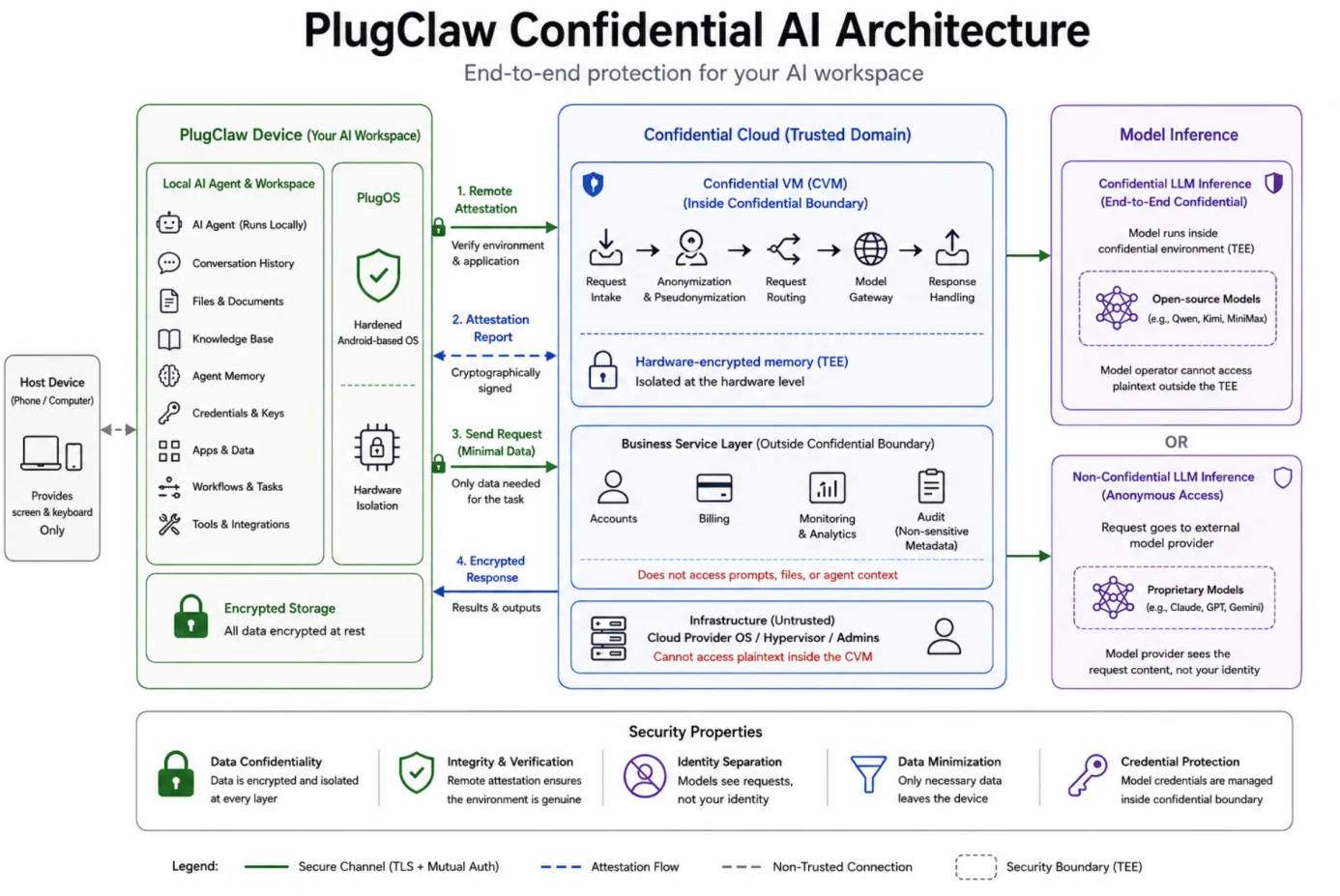
Para llevar la computación confidencial al mundo de los agentes de IA, PlugClaw utiliza una arquitectura de IA confidencial que protege los datos desde el dispositivo hasta el procesamiento en la nube y la inferencia del modelo.
El flujo de IA tradicional es sencillo: Usuario → Proveedor de IA → Modelo de IA. Envías tus consultas, archivos y contexto directamente al proveedor de IA.
PlugClaw adopta un enfoque distinto: Dispositivo PlugClaw → Nube confidencial → Modelo de IA confidencial / no confidencial. La nube confidencial se sitúa entre tus datos y la IA externa. Gestiona los datos más sensibles y controla exactamente qué se envía al modelo.
Dispositivo PlugClaw: tus datos se quedan en casa
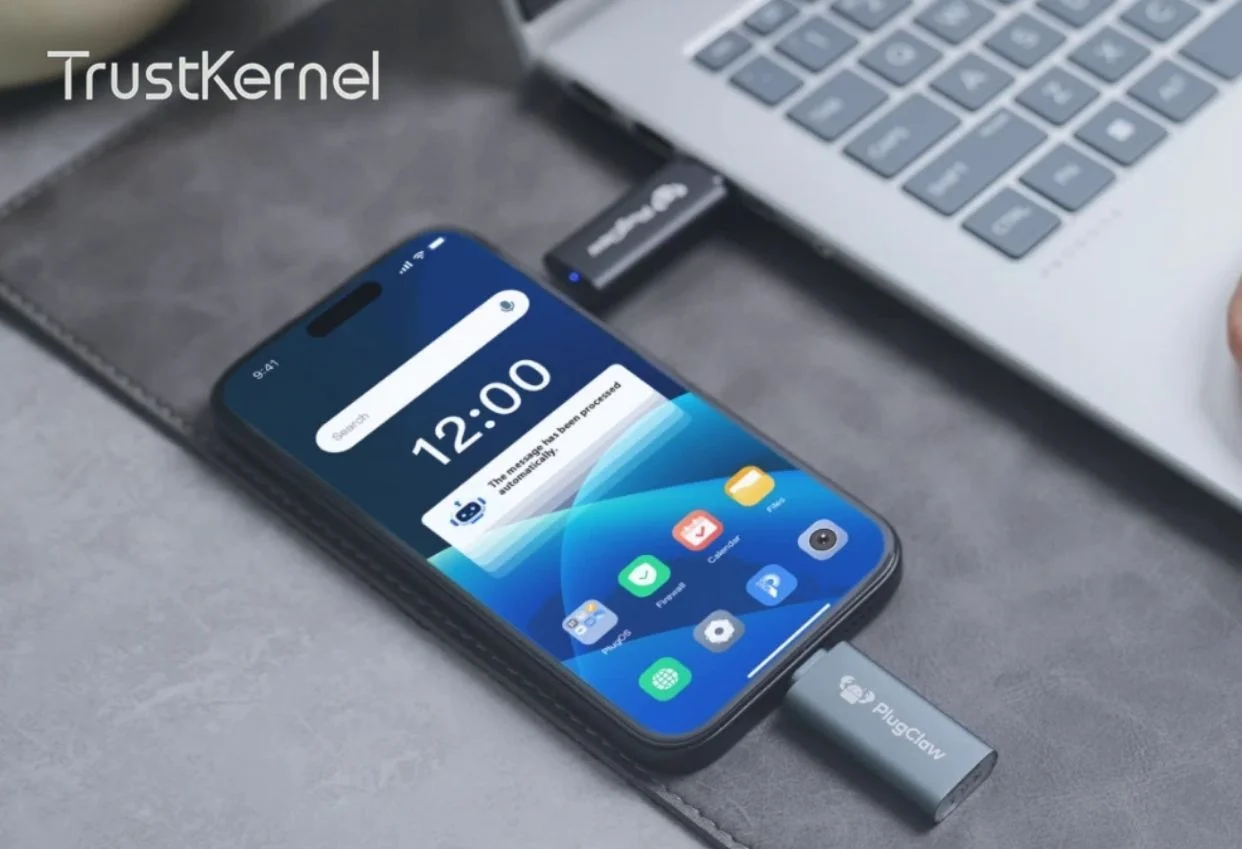
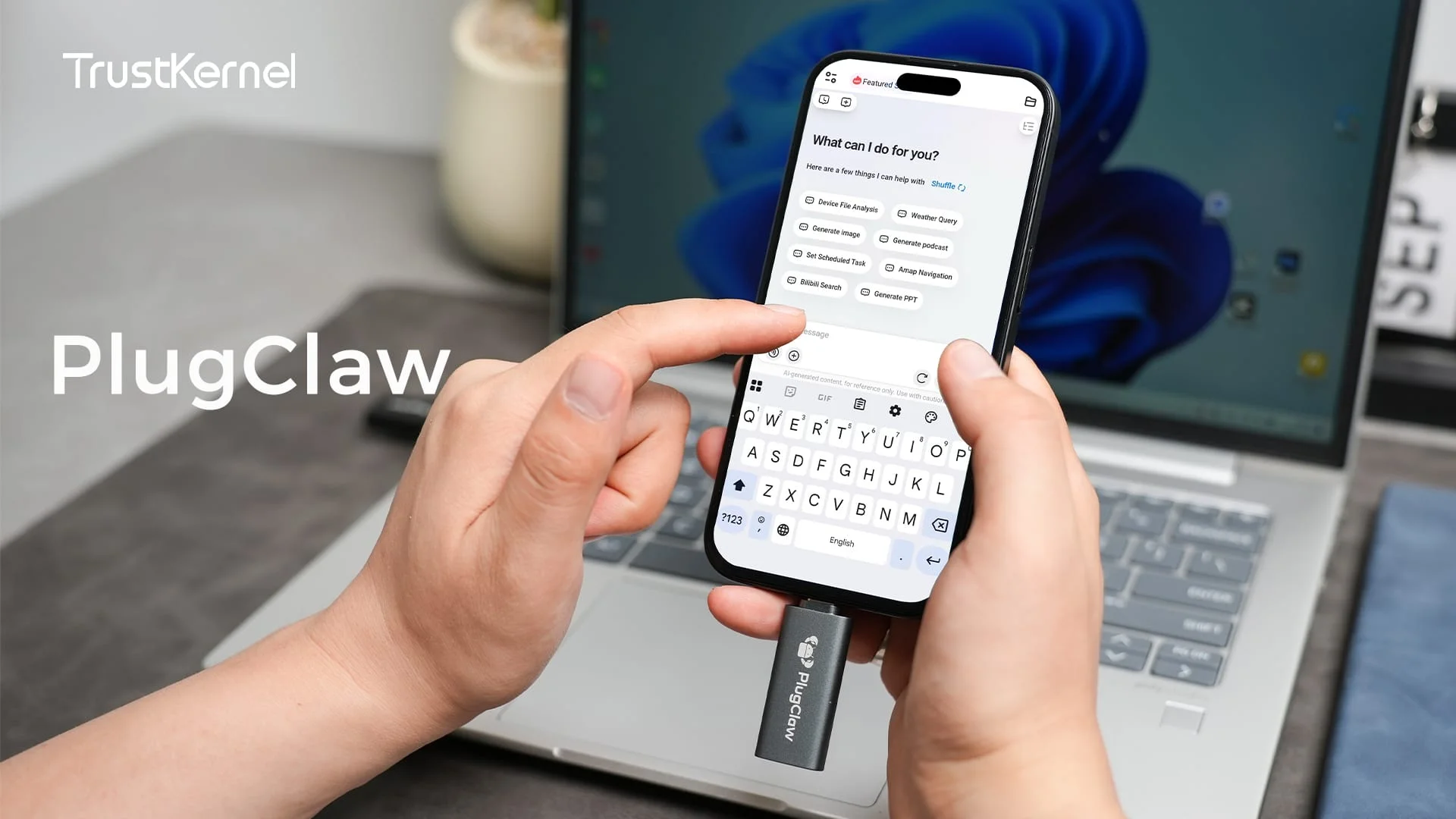
PlugClaw es una pequeña computadora de IA independiente, con su propia CPU multinúcleo, memoria y almacenamiento cifrado, que ejecuta un sistema Android endurecido llamado PlugOS. Se conecta a tu teléfono u ordenador por USB. Tu dispositivo anfitrión aporta la pantalla y el teclado, pero PlugClaw ejecuta su propio espacio de trabajo de IA de forma independiente.
PlugClaw no se ejecuta en tu teléfono u ordenador, y no gana acceso automáticamente a todo lo que hay en tu anfitrión. Tu historial de chat, archivos, base de conocimiento y datos de agentes viven dentro del almacenamiento cifrado de PlugClaw. Es tu espacio de trabajo de IA, no solo otra app.
Solo cuando una tarea realmente necesita potencia a escala de nube, PlugClaw envía la cantidad mínima de datos necesaria a la nube confidencial.
Nube confidencial: un entorno de IA protegido por hardware
La infraestructura en la nube de PlugClaw no es solo otro servidor.
Ejecuta cargas de trabajo de IA dentro de entornos de computación confidencial aislados por hardware, con distintas partes del servicio en la nube separadas en zonas de seguridad diferenciadas:
- La capa de servicio empresarial gestiona cuentas, facturación y registros, pero nunca toca tus consultas, archivos o contexto de agentes.
- El procesamiento real de datos ocurre dentro de máquinas virtuales confidenciales: enclaves protegidos por hardware.
Cuando PlugClaw se conecta a la nube, primero realiza una atestación remota para verificar que el entorno es genuino y ejecuta el código correcto. Solo entonces libera datos. Dentro de la VM, tus datos se descifran y procesan, y el texto plano solo existe dentro de ese espacio protegido por hardware. El propio SO de la nube y sus administradores no pueden leerlo.
Eso convierte a la Nube confidencial de PlugClaw en algo más que un proxy de API. Es un entorno de ejecución de IA protegido por hardware, diseñado para mantener los datos sensibles aislados durante todo el procesamiento del lado de la nube.
Inferencia de modelos: dos niveles de protección
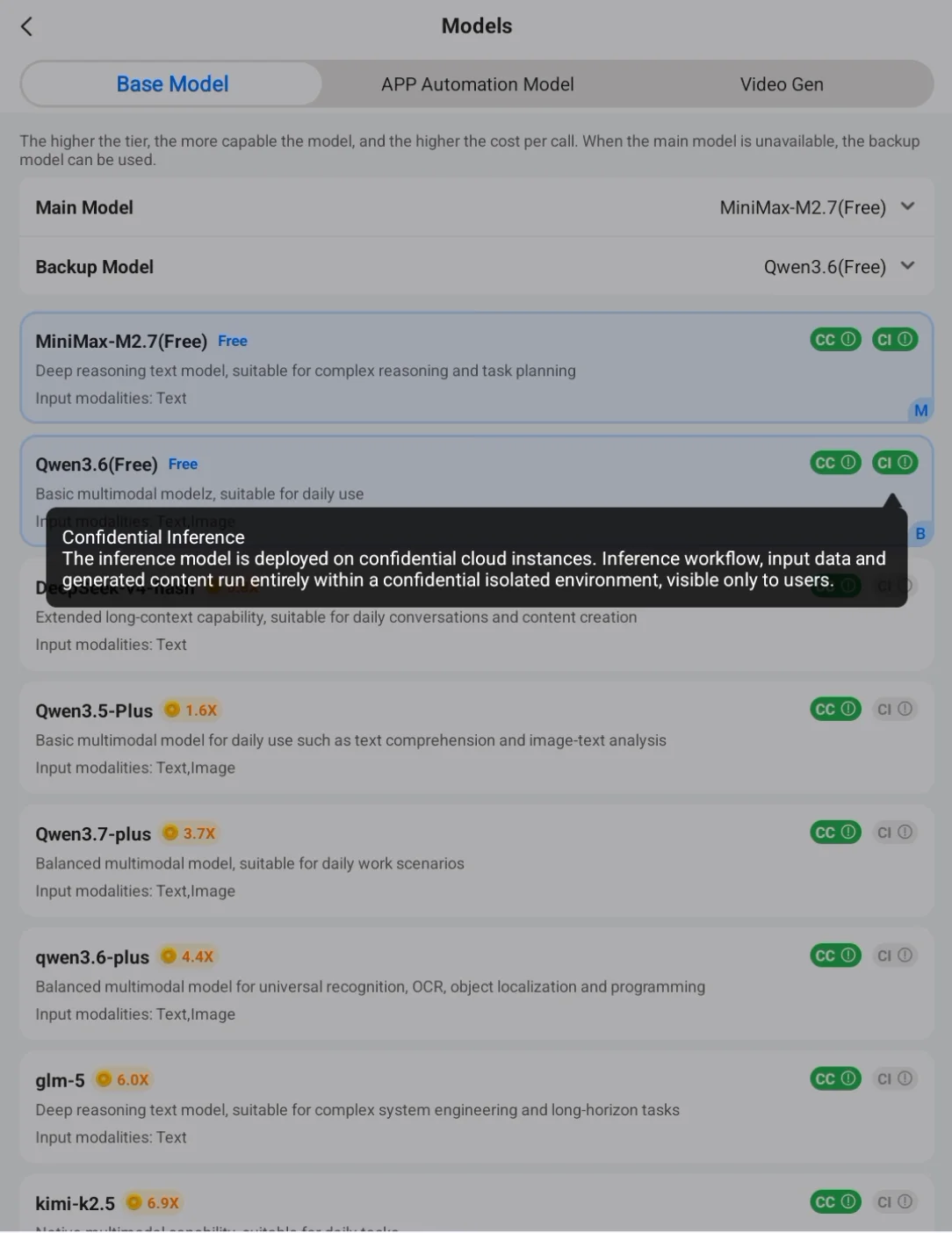
PlugClaw IA confidencial admite dos formas de usar modelos de IA. Puedes elegir el modelo que mejor encaje con la sensibilidad de tu tarea y el nivel de capacidad de IA que necesitas.
Inferencia confidencial: el propio modelo se ejecuta dentro de un entorno de computación confidencial dentro del dominio de confianza. Tus datos permanecen dentro de entornos protegidos desde PlugClaw hasta la inferencia y de vuelta. Ninguna parte fuera del entorno de ejecución de confianza puede acceder al texto plano, incluido el operador del modelo. Esta es la forma completa de IA confidencial, y el camino hacia la confidencialidad de extremo a extremo.
Inferencia no confidencial: con modelos de código cerrado como Claude, GPT y Gemini, el entorno de inferencia del proveedor del modelo está fuera de nuestro dominio de confianza. Por tanto, el proveedor del modelo puede ver el contenido en texto plano de la solicitud que procesa. En este caso, la Nube confidencial actúa como una pasarela anonimizadora. Protege tus datos originales, el contexto de los agentes y el procesamiento de datos dentro del entorno confidencial. El proveedor del modelo externo ve solo el contenido específico que realmente se envía al modelo.
Si uso un modelo de código cerrado, ¿sigue siendo «IA confidencial»?
Probablemente esta sea la pregunta más importante sobre el enfoque de PlugClaw para la IA confidencial.
En la arquitectura de PlugClaw, «confidencial» significa protección en tres capas diferenciadas:
- Confidencial respecto al dispositivo anfitrión: el sistema operativo, las apps o incluso el malware de tu teléfono u ordenador no pueden acceder a los datos almacenados dentro de PlugClaw. El aislamiento por hardware mantiene tu espacio de trabajo de IA separado del dispositivo anfitrión.
- Confidencial respecto a TrustKernel y al proveedor de nube: los datos se procesan dentro de máquinas virtuales confidenciales durante todo su tiempo en la nube. La computación confidencial y la atestación remota mantienen criptográficamente a TrustKernel y al proveedor de nube subyacente fuera del entorno de ejecución de confianza, de modo que no pueden acceder a tus datos.
- Confidencial respecto al proveedor del modelo: esto depende del modelo que elijas. Con un modelo de inferencia confidencial, toda la ruta de inferencia permanece dentro del dominio de confianza, ofreciendo confidencialidad de extremo a extremo. Con un modelo convencional de código cerrado, esta capa no se aplica: el proveedor del modelo puede ver el contenido en texto plano de la solicitud que procesa, pero, a través del enrutamiento anonimizado, no ve directamente a quién pertenece la solicitud.
Entonces, ¿por qué no usar simplemente modelos de inferencia confidencial para todo?
Porque la realidad actual es que muchos de los modelos frontera más capaces, incluidos Claude, GPT y Gemini, no están disponibles para su despliegue dentro de un entorno de computación confidencial.
Si «confidencial» significara renunciar al acceso a esos modelos, los usuarios volverían simplemente a la vieja elección: IA potente o privacidad.
PlugClaw adopta un enfoque distinto: dar a los usuarios la elección.
- Para tareas altamente sensibles (contratos, historiales médicos, información financiera y otros datos confidenciales), usa un modelo de inferencia confidencial para obtener protección de extremo a extremo.
- Para tareas que exigen los modelos frontera más potentes, usa modelos como Claude, GPT o Gemini, aceptando que el proveedor del modelo puede ver el contenido de la solicitud, manteniendo al mismo tiempo las demás capas de protección: acceso anonimizado y confidencialidad respecto a TrustKernel y al proveedor de nube subyacente.
Ten en cuenta que la mayoría de las operaciones sensibles del agente nunca salen del dispositivo PlugClaw. El agente lee tus archivos, opera aplicaciones y ejecuta flujos de trabajo en local. Solo el contexto necesario para la inferencia va a la nube. Tu historial de chat completo, tu biblioteca de archivos y tus patrones de comportamiento permanecen en tu dispositivo: ningún proveedor ve jamás la imagen completa.
Si uso un modelo no confidencial, ¿cuál es el sentido del relevo?
Otra gran pregunta. Si GPT o Claude ven igualmente mi consulta, ¿por qué no llamarlos directamente? ¿Por qué molestarse con la nube confidencial de PlugClaw?
He aquí por qué:
La identidad y el contenido se desacoplan. Cuando llamas a una API directamente, el proveedor ve tu cuenta, clave de API, IP, huella del dispositivo, y puede correlacionar cada solicitud que hayas hecho jamás en un perfil detallado. Con el tiempo, ese perfil es mucho más revelador que cualquier consulta individual. Con el relevo de PlugClaw, la VM confidencial elimina tu identidad y reenvía la solicitud usando una credencial compartida de la plataforma. El modelo ve una solicitud anónima desde la pasarela de TrustKernel, no a ti. (No afirmamos que esto haga la correlación absolutamente imposible, pero elimina las señales de identidad principales.)
El «intermediario» está dentro de la frontera confidencial. Los relevos ordinarios pueden ver todo tu texto plano; solo añaden otra parte en la que debes confiar. El relevo de PlugClaw es diferente: está dentro de un enclave protegido por hardware, así que el propio relevo tampoco puede leer tus datos. Un salto extra, pero no un par de ojos extra.
Los datos sensibles permanecen aislados de los sistemas empresariales. Tus sistemas de facturación, gestión de cuentas y registros nunca ven tus consultas ni tu contexto de agentes. Así, aunque un servidor empresarial sea vulnerado, los atacantes no obtienen tu espacio de trabajo de IA.
Gestión centralizada de credenciales. Si usas muchos modelos distintos, tendrías que gestionar claves y cuentas API separadas para cada uno. PlugClaw gestiona todo eso dentro del entorno confidencial, así que tus credenciales nunca quedan expuestas al flujo de trabajo del agente.
Arquitectura preparada para el futuro. Si un proveedor de código cerrado ofrece finalmente un despliegue confidencial, o si cambias a un modelo confidencial, tu canal no cambia. La arquitectura sigue siendo la misma; solo enchufas un modelo distinto.
Proteger todo tu espacio de trabajo de IA
Esta es la idea central de PlugClaw IA confidencial.
La seguridad de la IA tradicional tiende a centrarse en proteger una única consulta. Pero un agente de IA necesita algo mucho más importante: proteger todo lo que aprende y a lo que accede a lo largo del tiempo.
PlugClaw está diseñado para proteger todo el espacio de trabajo de IA: tu historial de conversaciones, archivos locales, base de conocimiento, memoria de agentes, contexto de tareas, llamadas a herramientas, credenciales, datos de aplicaciones e historial de trabajo a largo plazo.
Juntos, todo esto forma el espacio de trabajo digital con el que tu IA trabaja a diario.
Permanece en PlugClaw. Cuando se necesita cómputo en la nube, solo se envía a la Nube confidencial la información necesaria para completar la tarea actual.
Conclusión
La IA confidencial responde a una pregunta sencilla: ¿A cuántas personas debes realmente confiar para usar la IA más potente?
La respuesta tradicional es una lista larga: tu dispositivo, el proveedor de IA, el proveedor de nube, los servicios de proxy y todas las personas y sistemas que pueden acceder potencialmente a los datos a lo largo del camino.
PlugClaw adopta un enfoque distinto: hacer que esa cadena de confianza sea lo más corta posible. Tu dispositivo está protegido por aislamiento por hardware. La nube está protegida por computación confidencial. Cuando un modelo admite inferencia confidencial, toda la ruta puede ser confidencial de extremo a extremo. Cuando un modelo no lo admite, el entorno confidencial sigue controlando los datos, separa la identidad del contenido, minimiza lo que sale de la frontera protegida y envía al modelo solo lo que necesita para completar la tarea.
Tus datos te pertenecen. PlugClaw IA confidencial está diseñado para que la IA haga el trabajo por ti, manteniendo tu espacio de trabajo de IA como tuyo.
Suscríbete al boletín para recibir información exclusiva sobre seguridad y novedades
 PlugOS — La privacidad no es una opción. Es la base
Seguro · Sin publicidad · Sin rastreo · Sin recolección de datos en segundo plano
Copyright © 2024-2026 TrustKernel
Política de Privacidad | Acuerdo de Servicio al Usuario